
Finding Creativity in the Face of Fear
Why I thought my imagination had dried up, and how we all can fill our cups again to get writing.
Welcome back to Smut Ed, my deliciously devious band of wordsmiths.
It's been a while, and the reason is one I want to touch upon in today's article. A big struggle I face due to mental health in own writing is coming back to it when the momentum has fallen, or when my inner critic and shame-bug have crawled beneath my skin. Creative spirit, especially for writers, is often viewed as a phantasmal force, one that exists outside of us and can only be accessed via a series of specific strategies, such as isolating along a pond in Massachusetts a la Thoreau, or via a content garden of inspirational prompts that will definitely make you a bestseller, charging six monthly payments of $19.991.
But while all these tools try to serve you access to your own well of imagination, know that it’s not something that can be commodified. Rather, creativity is a tool that sits on our mental bench, waiting for us to reach out and ask it to play. And when a good portion of our social interactions, personal security, and intellectual development are being sold to the highest bidder online, being able to play becomes crucial.
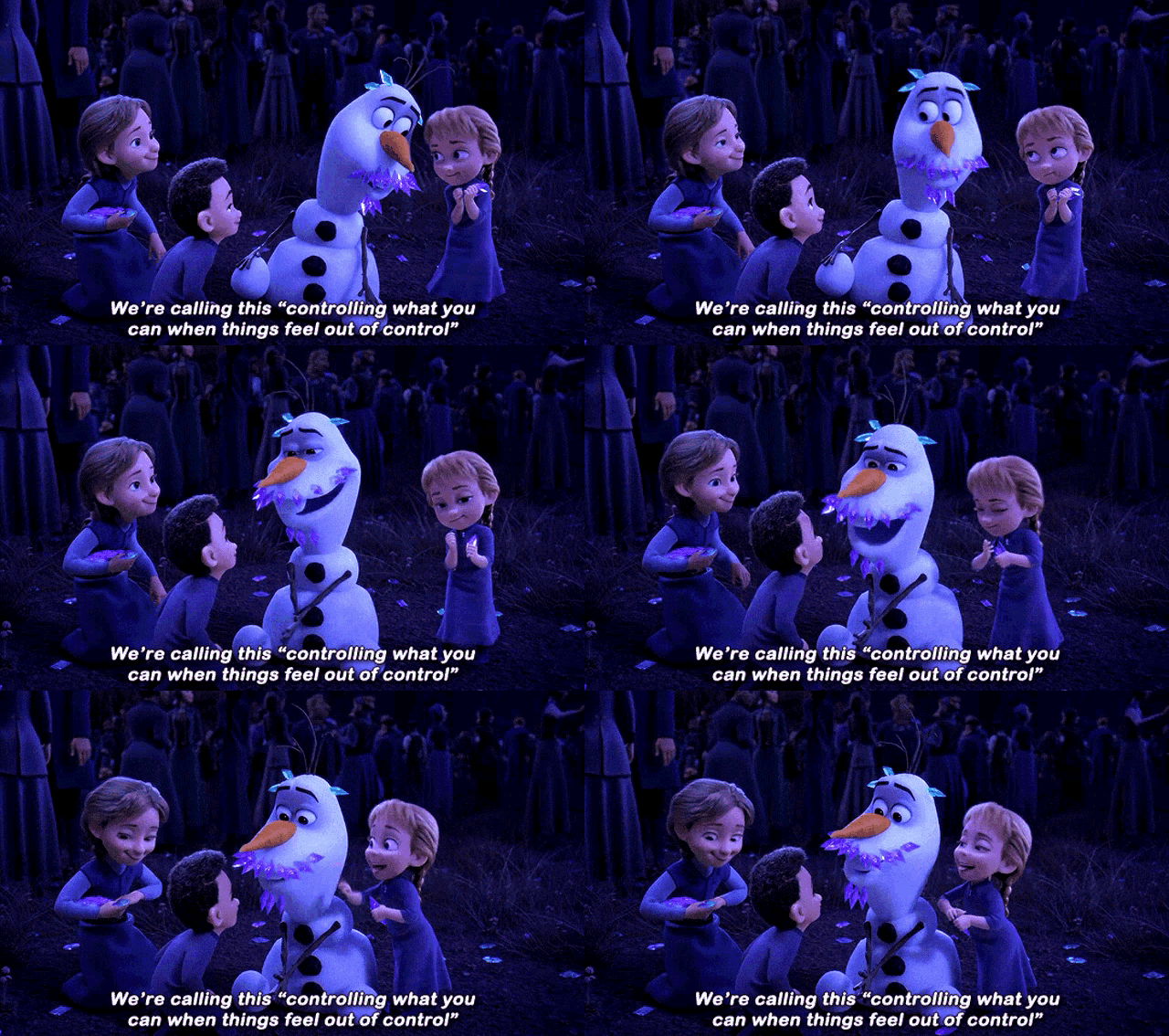
If you've been awaiting a divine bolt of excitement in working on your book or idea for years, using only hyper-focused storms to create that have trouble staying consistent beyond the hours of 10 p.m. and 4 a.m., then this article may be for you.
Facing My Inner Critic's Heaviest Hitters
In pitching myself as an expert in my field, I want to be transparent about the foundation of my work, and why what I do now is important.
I went into editorial because I was afraid.2
When I built my editorial business and tackled my why, I decided on "wanting to help people tell their stories." And while that is still true, it took me a long time to unpack a second, unspoken part of that why.
"I want to help people tell their stories because I'm afraid to tell my own."
You might imagine how hard that one was to swallow, especially as someone who touted themselves as a seasoned storyteller. For a decade, the unrevised manuscripts on my shelf, the dozens of homeless stories and chapters on my hard drive, all finished the silent suffix for me. I allowed my shame to cast my creativity to the wayside, and with it, a large aspect of my sense of self.
After seven years in editorial, countless new therapy sessions and medical diagnoses3, and peeling back the layers of my spirit that have kept my creativity at bay, I'm slowly coming back home to myself. In doing so, I've held strong to my love of writing, creativity, and storytelling. I'm working on a new book I'm hoping to revise and publish soon, but I'm also here, writing articles about sexuality and fiction. I'm drafting content for authors to dissect their smut writing process and find new trailheads of creative exploration.
My definition of what makes a story worth exploring has widened, and my creative spirit has been all the better for it.
Redefining Play
So, while I'm still helping other writers craft their work, I'm tackling my why again, this time for the person and writer I want to be. The person who would make Little Me, who stapled pages to make comics and handwrote self-insert romance fanfiction with her best friend, proud. That girl was an expert at exploring her feelings and the world around her through the act of play.
I started writing as a child to traverse realities and truths that didn’t exist in the world I could touch and see. Especially with an unknown autism diagnosis, I used stories to translate the world around me and process my interactions. In doing so, I met others who did the same, and it made wanting to continue my own play and exploration that much easier.4
But as I grew older, the world grew crueler. Or my eyes just opened to the cruelty that had always existed beneath the surface.
On multiple occasions and in more ways than one, I let other people's actions and opinions dictate my actions for more than ten years. My sense of play became a festering splinter in my side, one too childish to dare touch.
But that's exactly what writing is—childish. It's a form of magic, one that allows you to create worlds and grand love stories from nothing, explore creatures and characters out of dreams and nightmares, all behind the safety of holding a pen and paper or typing on a keyboard.
Writing is play. And I spent ten years losing that realization to fear.
In the United States, we're currently experiencing a surge of conservative censorship, including the censorship of informed and safe displays of sexuality, kink, and disability in the media.5 At this point, it’s hard to tighten the lens and take action as individuals to help such a systemic and far-reaching problem. And while there are absolutely things we can do no matter your prerequisites, to engage in play in the face of censorship is and always will be an act of revolution.
Finding joy and peace in mundanity is a valid tactic to surviving oppression. To read and write books about sex is resistance. To support and spread the education of media literacy, both sexual and nonsexual, is mutual aid. To continue to create and build in the face of fear is strength6.
To play is to be alive.
Where I Find My Sense of Play
Here are a few things I've been doing to add to my sense of play and exploration in ways that are accessible to me in the face of my fears.
Diving back into Brandon Sanderson’s Cosmere and reminding myself worldbuilding doesn't have to be overwhelming, I'm just not Brandon Sanderson (and have no interest in being him)
Binging romantic comedies and analyzing their writing styles for nuggets I can utilize despite my inner critic's ranting about public perception (Crazy Ex-Girlfriend being taken off streaming should have been a crime, but it’s driven me back to using DVDs)
Engaging with my local kink community and catching up on our current book club read, the Sex Wizards series by Alethea Fox (the magic system is kink-based, and I am over the moon)
Getting in touch with my inner child and teenager, both of whom shaped my relationship with creativity and shame (I highly recommend No Bad Parts by Richard Schwartz and a really great IFS therapist)
Using Dungeons & Dragons/Baldr’s Gate as a tool for inspiration, exploration, and learning the consequences a character's actions (Everything I Need to Know I Learned from RPGs by Jeff Ashworth is an amazing resource)
How You Can Find Play Again
After letting creativity and joy slink into the background, it can feel impossible to yank them back out from their criticism-mucked prison.
But on many occasions when I was little, my mother and grandmother both taught me how to clear my hair of knots: separating one strand at a time. Work strand by strand, massaging through small bunches using the tools you have.7
Open yourself to small forms of play by redefining what it can look like. Doodle on the corners of your date book. Rewrite a movie's ending in your head or on a page. Give yourself the opportunity to ask, "What if?" and be open and supportive of whatever surfaces.
If your creative spirit remains stifled, know that it takes time to build (or rebuild) the self-trust required for uninhibited creativity.
One of the most important tips I can give to someone seeking to let their analytical and critical brains take a rest is to do what your body needs to feel safe. This is crucial when it comes to kink and sexuality, both of which are often overshadowed by insecurity and confidence issues regarding the perception of ourselves and others.
If you happen to be in a period or space in your life that is affecting your body’s sense of safety (this can mean being in literal danger, but it can also mean being in fight-or-flight and burnout), you may find accessing your sense of play more difficult. This is not at all to dissuade you from trying, but it is to give you an honest lay of the land.8 Conversely, working with your inner child and embracing your creativity can also help regulate your nervous system, so it’s up to you to decide where you in the equation is best to start.
A Word on Knowing Yourself
When it comes to allowing your creative spirit to fly, pushing it off the edge by force can give you the opportunity to spread your wings and find your own way. But it can also be how you find out your wings have been clipped before you've had the chance to heal.
It takes self-awareness and grounding to know where you are in your journey and what your outcome on the other side of that mountain might be. But as someone who dove and was lucky enough to have people supporting me on the landing, just know that sometimes the trust-fall is worth it. All it takes is the next step, the next word, the next verse we contribute to the powerful play that will go on long after we’re gone.
What will your verse be?9
As an online content creator and writer, I have to joke about the difficulty in charging people for educational content and access to community. If I weren’t as constrained by my need to pay my bills and help provide for my family, I would offer all my services and writings for free.
That's not to say it was only out of fear. I was incredibly brave in committing to freelance and working in the publishing sector when a job in other industries might have provided more security and income.
Hunting and advocating for disability care and treatment is exhausting. Doing it as a freelancer is doubly so, and I anyone else who is out there chugging along, I wish you all the strength and rest you can manage.
Fun fact about me, I had somewhere between fifty and seventy-five theatrical productions under my belt by the time I was eighteen. From around five until I graduated, I was consistently in either an audition process, a class, rehearsal, or the run of a show.
This is incredibly dangerous, as “sexual content” can mean anything involving sexual health and wellness, reproductive health, LGBTQ+ resources and media, and is often biassed against marginalized communities (as shown in the ACLU article).
While I fought the urge to include a GIF from Rent of Mark Cohen hand-dancing, I would be remiss to exclude Jonathan Larson’s quote here directly: “The opposite of war isn’t peace, it’s creation.”
My grandmother used oil; my mother used conditioner.
This post is a letter to my inner urge to quit, and I hope in publishing it I can have more evidence to return to in my times of need.
Seize the day, wordsmiths. Carpe diem.